Posts

PARIS AGREEMENT: NIGERIAN YOUTH SET AGENDA FOR INCLUSIVE IMPLEMENTATION

Image
Representatives of Nigeria Youth at the Inclusion Dialogue   August 12th is globally recognised as the World International Youth Day.  To help advance youth inclusion to the core of the implementation of the NDCs, Climate and Sustainable Development Network (CSDevNet), in collaboration with the National Civil Society Framework on Paris Agreement and the SDGs (NCFPAS) and the Pan-African Climate Justice Alliance (PACJA) convened a National Youth Discussion on Nigeria Youth Inclusion and the Implementation of the Nationally Determined Contributions (NDCs).  I was one of the young people who attended the event in my capacity as a part of the CSDevNet team.  The discussion sought to collate ideas, knowledge and draft a work plan that will inform, encourage, and influence leaders to raise the ambition of their commitments to the NDCs.  The discussion took place at CSDevNet’s Secretariat in Abuja, Nigeria, from August 12 to 14 2019.  Di...

INSIDE THE WORLD OF NIGERIA’S INFORMAL WASTE WORKERS

Image
Sabi'u, a Nigerian waste picker The informal waste workers are people who make a living from waste but are not formally tasked with providing the service by the authorities. Common names for the category of waste workers in this article are baban-bola, onye mkpo ahihia, kole kole, asa-idoti, scavengers, and waste pickers. The data I will be referring to in this article is from a survey of six dumpsites (illegal and government-approved) in Abuja, Nigeria. The average age for a male informal waste worker who makes a living out of Abuja’s dumpsites and bins is 23 years, they are mostly migrants from other states in the Northern part of Nigeria such as Nassarawa, Kano, Katsina, Zamfara, and 72% migrated to Abuja in search of greener pastures within the last five years. Some of the occupations they were engaged in prior to relocation are farming, vehicle repair, equipment operation, and so on; some of them also mentioned that they were jobless before re...

PPT PRESENTATION ON THE INTEGRATION OF INFORMAL WASTE WORKERS INTO NIGERIA'S SOLID WASTE MANAGEMENT SYSTEM: BARRIERS AND SUCCESS FACTORS

The Integration of the Informal Waste Sector into Nigeria's Solid Waste Management System: Barriers and Success Factors. from AdesuwaObasuyi

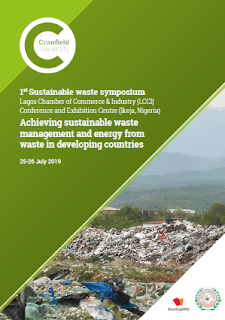
SUSTAINABLE WASTE SYMPOSIUM ON ACHIEVING SUSTAINABLE WASTE MANAGEMENT IN DEVELOPING COUNTRIES

Image
In developing countries such as Nigeria, the challenges associated with waste management are often multi-dimensional and as such require new perspectives, energy and resources. Having identified this, Cranfield University and West Africa Energy is set to host over 100 participants for a 2-day Waste Symposium at the Lagos Chamber of Commerce and Industry, Lagos State, Nigeria on 25th – 26th July, 2019. The symposium is themed ‘Achieving sustainable waste management and energy from waste in developing countries’ and aims to bring together experts working in the waste and resource management, energy production and environmental engineering sectors from industry, financial services, academia and government organisations. Cranfield University is a postgraduate UK university with focus on research and a mission to create leaders in technology and management, unlocking the potential of people and organisations by partnering with business and governments to deliver transform...

MY TAKEAWAYS FROM UDOL'S SEMINAR ON EMBEDDING SUSTAINABILITY IN VALUE CHAINS

Image
Corporate sustainability is critical to environmental social governance and provides stakeholders including investors, clients, customers, employees, shareholders, and regulators with trust that an organisation is focused on reducing costs, minimizing risks and increasing resilience. With my thirst for knowledge and quest to know more about corporate sustainability, I applied for and was accepted to participate in a free seminar on Embedding Sustainability in Value Chains of Public and Private Organisations which was organised by the University of Derby Online Learning. The training held in Abuja and had over 30 delegates from various disciplines ranging from Environmental Science to Law and from different parts of Nigeria. The training session opened with the facilitator Dr Uchechukwu Okere (PhD), the Academic Lead for Environmental Management from the University of Derby, asking us to exchange ideas on if the private sector or the government should lead the drive for s...

MY TWEETCHAT ON GENDER AND OCEAN

Image
Gender and Ocean Tweetchat Poster I recently had a tweetchat with Rees Africa (a non-governmental organisation positioned to redefine Africans' lifestyle with renewable energy and environmental sustainability) to commemorate World Oceans Day 2019 which was themed ‘Gender and Ocean’. Below are the questions and my responses: Q1. By way of introduction, what is the importance of oceans in Earth’s ecosystem? A1. Oceans and seas connect and sustain us. They are home to vast biodiversity and are a vital defence against the global climate emergency. Among other ecosystem services, oceans provide over half of the world's oxygen (O2) and also absorb carbon dioxide (CO2) from our atmosphere. Also, research has stated that the oceans have absorbed more than 90% of the warming created by humans since the 1970s, had that heat gone into the atmosphere, global average temperatures would have jumped by almost 56 degrees Centigrade (100 degrees Farenheit). I’m sure that gives you an idea...

CLIMATE CHANGE AND MENTAL HEALTH: LESSONS FOR NIGERIA

Image
Introduction The question of how to tackle the consequences of a changing climate is set to become one of the most significant issues of the coming years as many Nigerians come to terms with the complexities associated with the impacts. Mental health refers to emotional, psychological and social well-being. Studies in various parts of the world have shown linkages between climate change and mental health, and a term ‘solastalgia’ was coined by Albrecht and colleagues, it describes “environmentally-induced distress and negative emotions caused by destruction or diminishing of place of solace, communities and landscapes”(1,2). Major mental health impacts include increases in the incidence of stress, anxiety, depression, suicide ideation as well as increases in more severe reactions like pre-traumatic stress disorder and post-traumatic stress disorder (3). Research indicates that women, children, old people and other marginalized groups are especially vulnerable to the mental healt...